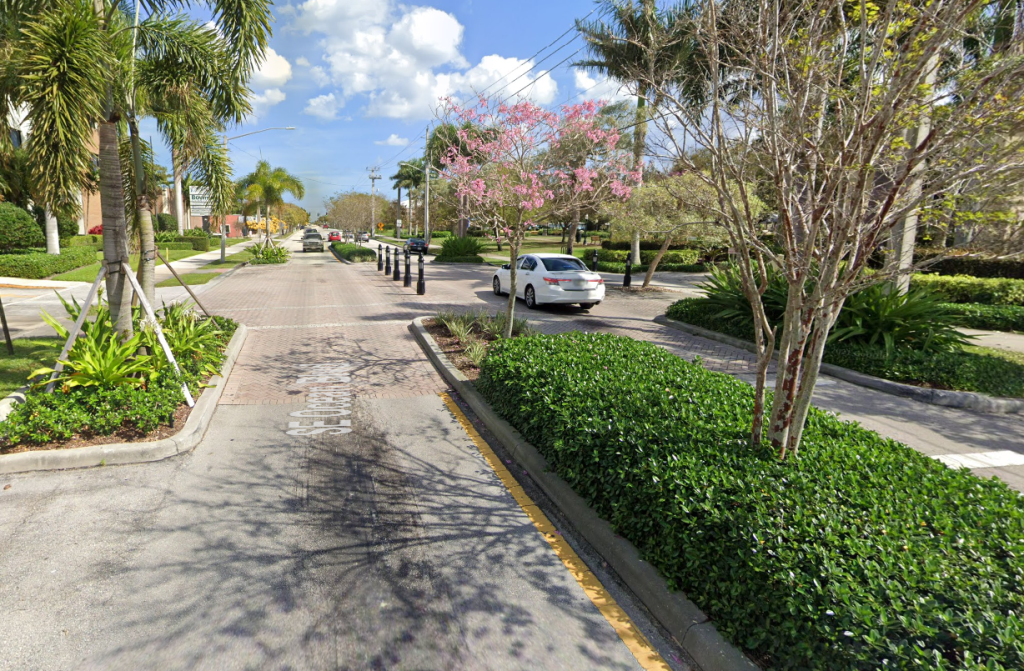
Design drives how people interact with their environments. People only do what feels safe, comfortable, and convenient. We believe if it’s not designed for both an 8 year old biking on their own, or an 80 year old using a walker, then it isn’t a safe street.
Car crashes continue to be the leading cause of death for our young residents (age 5-24) in the Treasure Coast. Their deaths are preventable.
The following are some of the modern best practices we support that allow safe streets for everyone:
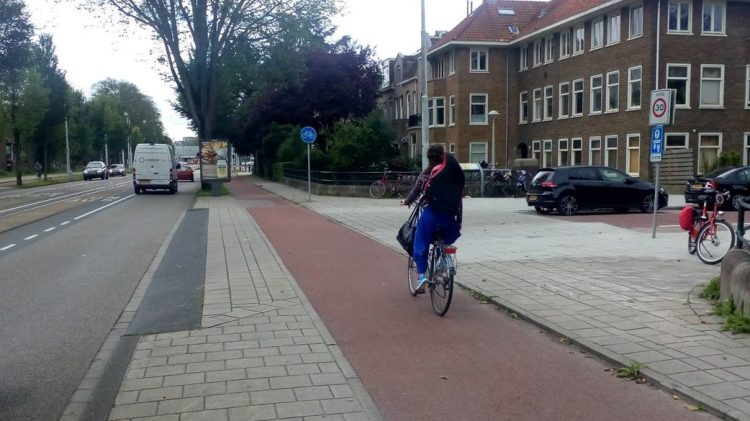
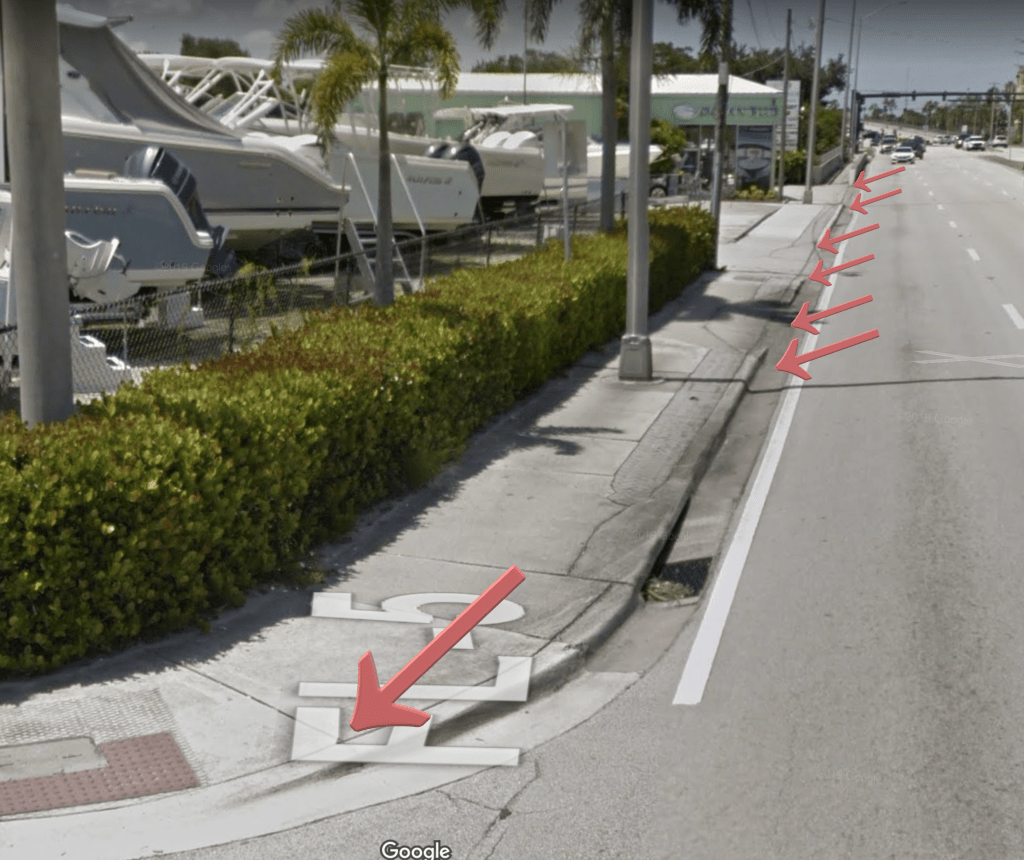
Continuous Level Path
- Raised crossings keeps turning vehicles to safe speeds, alerts drivers to look out for people walking and biking.
- Eliminates hazardous and uncomfortable “cross slope”.
- Each level transition of sloped angle is an opportunity for people walking, biking (especially children or the elderly on tricycles), or using a wheeled mobility assistance device, to fall into traffic.
- Paths must be sufficiently wide
- 6ft for a one-way path adjacent to a sidewalk
- 12ft for a two-way trail adjacent to a sidewalk
- A 10ft trail is only OK in more rural contexts (no adjacent businesses)
- Properly designed, these include visual cues for to visually impaired while greatly reducing tripping hazards and vehicle-pedestrian conflict speeds.
VS
Shade and Nature
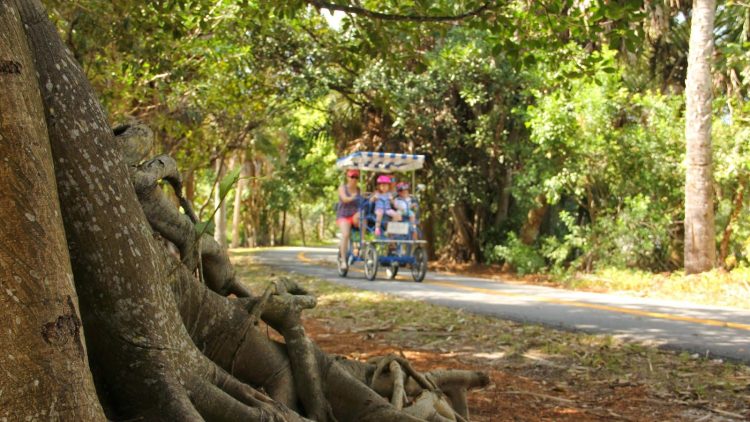
In hot, humid Florida – shade is more than just a “nice to have” – it’s a necessity for infrastructure to be useful to all. While continued exposure to full sun is at best merely unpleasant to some people, it presents a health concern for much of our population. Heat stress on the elderly as well as many common medical conditions mean long stretches of hot sun are not just uncomfortable – but dangerous.
On a 90 degree day, surface temperatures of asphalt in the sun can exceed 140F. In contrast, under a deep canopy of trees they are 85F. Not only do they cast shade that blocks the sun, they also perform evaporative cooling – dropping the temperature even lower.
In addition, trees buffer people from cars, enhancing the safety and comfort of people walking.
Trees are best integrated by:
◾ Preferentially keeping paths to South and West sides of streets to best cast shade on the path itself
◾ Avoiding route placement under power lines. FPL has aggressive trimming rules, so paths should preferentially be placed where they can be better shaded
◾ Adding a metric for all new routes and projects that requires an estimated “percent of sidewalk covered by shade” under realistic tree-growth condition. A crape myrtle planted every 20 feet will never provide a shaded route. Marathon Key and Barcelona have implementation examples of percentage shade coverage requirements that could provide a good model for Stuart.
Humans and high-speeds don’t mix
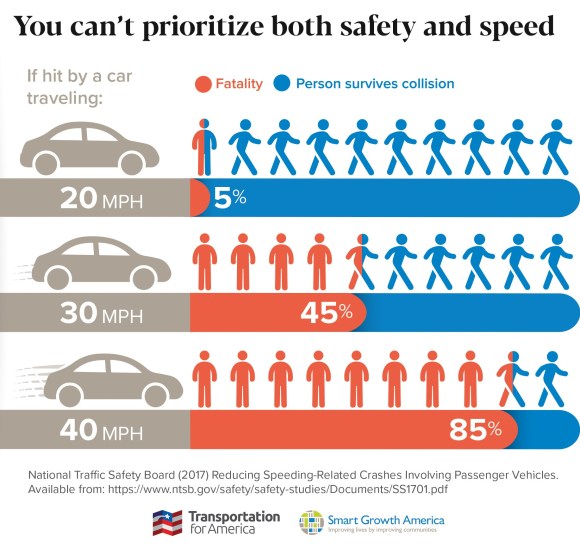
In places where people, bikes, and cars are all present, public spaces should be designed to ensure safe speeds.
- Human bodies can only handle impacts at about as fast as people can run – about 20mph. Beyond this, danger increases exponentially
- Therefore, physically separation is needed from vehicles exceeding 20mph
- This doesn’t mean all cars have to go 20mph everywhere – just that psychical separation and protection is needed for people when cars are fast. Properly designed curbs, street trees, and driveway entrances are needed to ensure a errant vehicle doesn’t kill people walking and biking. Currently, most of our road designs use bike lane and sidewalk areas as “recovery zones” for inattentive drivers.
Physical protection involve more than just a grassy shoulder – a median, concrete wall, planters, parked cars, or trees all increase safety and comfort.
If it’s too scary to let your child walk in it, it’s not a safe bike lane or sidewalk.


Public Places
City streets are public places – just like parks, plazas, or shopping districts. Traditionally over the millennia, they have been treated as such shared spaces.
The ones we love most should therefore be designed in such a way that reminds us that they can sometimes be used as parks and plazas. Curbless and well shaded streets allow easy and safe conversion to plazas for events and busy times of year.

Street Geometry
When it comes to how design enhances safety, the actual physical layout and cues of the street layout are one of the biggest factors.
Speed limits (to most people) are merely suggestions – drivers actually pick the speed they drive on a given road based on many subtle and seemingly invisible cues.
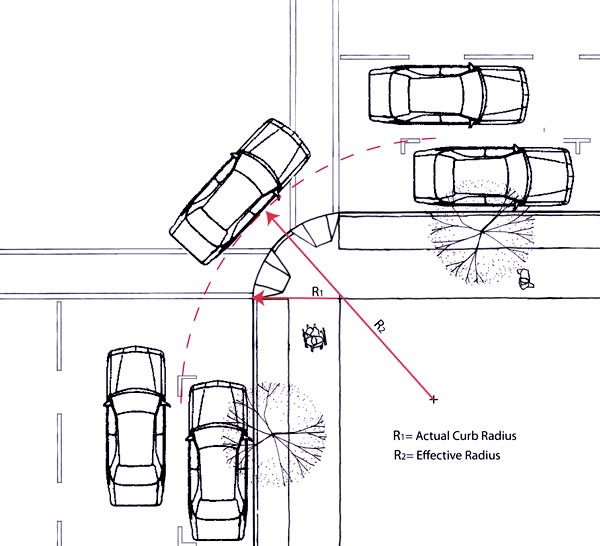
Lane width, crosswalk design, the radius of curbs, the drainage shape of gutters, and the look of the pavement are just a few of the many parameters our brains use to decide how fast we should be traveling on a street.
It is therefore critical that we design our streets in a way that causes drivers to go the speed we want. Currently, most cities still use an outdated practice where they build a street, record how fast people drive, then set the speed limit based on that recording.
Modern best practice says that we as a community should decide how fast we want cars on any given street and then design it accordingly.
While there are many factors, three of the important and easy to spot ones include:
- Vertical Deflection
- The most recognizable (and unpopular) of the options for vertical deflection is a speed bump.
- Less controversial and more effective options include raised crosswalks, steeper curb ramps, gutter-drainage, inverted-crown drainage (street drain is in the middle instead of the outside), and more
- Horizontal Deflection
- Any turn is a type of horizontal deflection
- When added intentionally, they can be designed in such a way to pick what speed drivers choose to go
- Examples include bulb outs, roundabouts, chicanes, lane shifts (eg, at medians), neighborhood traffic circles, and more
- Curb Radius
- One of the more counterintuitive practices to increase road safety is through decreasing the “swoopyness” of intersections of curbs
- If curbs meet at an intersection at a perfect square, that would be known as a 0 foot curb radius. This is the tightest possible, and might causes drivers to pop their tires, so is rarely used.
- Older highway guides suggested a curb radius of 50′ or higher, to allow cars to make high speed turns. While this makes sense on highways, these standards were unfortunately applied to our town centers where we live and work. This resulted in many preventable deaths.
- Modern best practices often involve reducing curb radii down to as little as 5 feet. Design considerations are needed for large trucks, but can often be handled using other road geometry tools.
- Tight curb radii also reduce the time and distance people walking are exposed to traffic – this can reduce the length of a crosswalk by half!